Ticket Classes
Required Role
Administrator or Box Office can create and edit ticket classes. Only Administrators can delete ticket classes or modify pricing after sales have occurred.
Navigation: Productions > [Production Name] > Ticket Classes > New ticket class
What Is a Ticket Class?
A ticket class defines a type of ticket available for a production -- its name, price, fees, and behavior. A single production typically has multiple ticket classes (e.g., General Admission, Senior, Student, Comp). Each ticket class can be independently configured for visibility, exchange rules, and special behaviors.
When a new production is created, it automatically receives copies of the theater's default ticket classes. You can then modify, add, or remove classes as needed.
Creating a Ticket Class
- Navigate to the production's detail page
- Click New ticket class in the Ticket Classes section
- Fill in the fields described below
- Click Create Ticket class
Core Fields
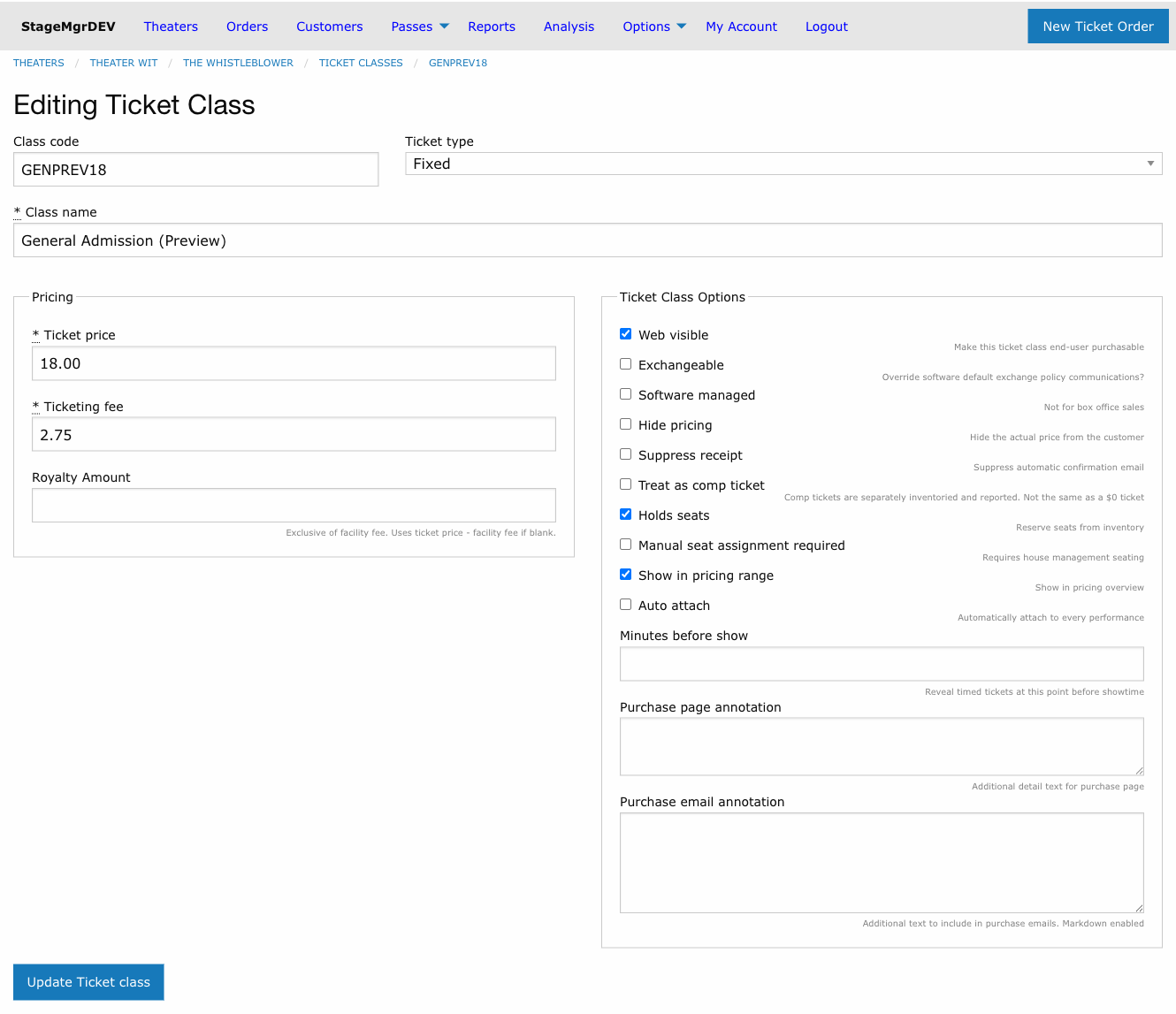
Class Code
A short identifier that uniquely identifies this ticket class within the production. Minimum 1 character. Auto-uppercased on save. Used in reports, performance allocation tables, and internal references.
Code Conventions
Common codes: GA (General Admission), SR (Senior), STU (Student), COMP (Complimentary), VIP (VIP), RUSH (Rush). Keep codes short and consistent across productions.
Class Name
The display name shown to patrons on the purchase page, in confirmation emails, and on printed tickets. Examples: "General Admission", "Senior (65+)", "Student with ID".
Ticket Type
Controls how the ticket class behaves in the system.
| Type | Behavior |
|---|---|
| Fixed | Standard ticket with a fixed price. The most common type. |
| Donation | Treated as a donation rather than a ticket sale. The price field becomes the suggested donation amount and can be changed after sales begin. |
| Timed | Hidden from the purchase page until a specified number of minutes before the performance. Used for rush tickets or day-of sales. |
Ticket Price
The face value of the ticket in dollars. Required. Entered in increments of $0.25.
Price Lock After Sales
Once any ticket of this class has been sold, the price cannot be changed -- except for Donation-type classes, which allow price adjustments at any time.
Ticketing Fee
The per-ticket fee charged on top of the ticket price. Required. Entered in increments of $0.25. This fee appears as a separate line item on the patron's receipt.
Royalty Amount
An optional override price used exclusively for royalty report calculations. Exclusive of facility fee. Entered in increments of $0.25.
When blank, the royalty report uses ticket_price - ticketing_fee as the royalty basis for that ticket class. When set, the royalty amount is used directly.
Example: A subscription ticket class might have a ticket price of $0.00 (subscribers pay through their flex pass), but a royalty amount of $25.00 so that the rights holder is compensated as if a $25 ticket was sold.
When to Set Royalty Amount
Set this field when the ticket price does not accurately reflect the value that should be used for royalty calculations. Common cases include:
- Subscription/flex pass tickets priced at $0 that should count toward royalties at a standard rate
- Supporter tickets where a portion of the price is a donation -- set the royalty amount to just the ticket portion
- Discount classes where the royalty agreement specifies a fixed per-ticket rate regardless of what patrons pay
Visibility and Access
Web Visible
When checked, this ticket class appears on the public purchase page and patrons can buy it online. When unchecked, the class is available only through the box office interface.
Example: An industry comp class might have web_visible unchecked so that only box office staff can issue those tickets.
Software Managed
When checked, this ticket class is managed entirely by the system and is not available to box office staff in the manual order interface. Used for ticket classes that are only assigned programmatically (e.g., through automated promotions or integrations).
Hide Pricing
When checked, the ticket price is hidden from the patron on the purchase page and in email communications. The ticket class name still appears, but no dollar amount is shown. Useful for complimentary or sponsored tickets where displaying "$0.00" would be awkward.
Email and Receipt Behavior
Suppress Receipt
When checked, the system does not send a confirmation email when this ticket class is purchased. Use this for internal comps, house seats, or other transactions where patron notification is not desired.
Purchase Page Annotation
Text that appears below this ticket class on the purchase page. Use it for eligibility notes, restrictions, or instructions. Example: "Valid student ID required at door."
Purchase Email Annotation
Text included in the confirmation email for orders containing this ticket class. Markdown enabled. Use it for class-specific instructions. Example: "Please arrive 15 minutes early for will-call pickup."
Inventory and Seating
Holds Seats
Default: checked. When checked, each ticket sold deducts from the performance's available inventory. When unchecked, tickets of this class do not reduce availability.
Unchecking Holds Seats
Only uncheck this for ticket classes that should not affect capacity -- such as add-on items, parking passes, or program book sales. Selling tickets that don't hold seats can lead to overselling.
Assigns Seats
Default: unchecked. When checked (for reserved seating productions), box office staff can manually assign or reassign specific seats to tickets of this class. When unchecked, seats are assigned through the standard checkout flow.
Complimentary
When checked, tickets of this class are treated as comps. Complimentary tickets are separately inventoried in house count reports and tracked distinctly from paid sales. Typically paired with hide_pricing.
Show in Pricing Range
Default: checked. When checked, this ticket class's price is included in the price range displayed on the production's public listing (e.g., "$25--$45"). Uncheck for comps or special classes that would skew the displayed range.
Zone ID
Default: * (any zone). For reserved seating productions, restricts which seats this class can be sold into. A class with Zone ID * sells into any seat; a class with a specific zone (1--2 letters/digits, e.g., B) sells only into seats whose zone matches. Seat zones are assigned in the seat map editor.
The match is enforced everywhere -- the public seat selector hides non-matching classes, the server rejects mismatched sales, and reseating cannot move a ticket across zones (use an exchange instead). Multiple classes may share a zone (e.g., STUDENT, GENERAL, and SENIOR classes all with Zone ID A), and the class code does not need to mention the zone. General admission productions ignore this field.
Pricing by section
To charge more for premium seats, zone those seats (e.g., zone P) in the seat map editor and create ticket classes with Zone ID P at the premium price. Keep wildcard (*) classes for tickets -- like subscriber redemptions -- that should work anywhere in the house.
Exchange Behavior
Exchangeable
Controls whether tickets of this class can be exchanged by patrons or box office staff. When unchecked, this ticket class is excluded from the exchange flow regardless of the production's general exchange policy.
Timed Ticket Settings
Minutes Before Show
Only applicable when Ticket Type is set to Timed. Enter the number of minutes before the performance start time when this ticket class becomes visible on the purchase page.
Example: Setting this to 60 makes the ticket class appear one hour before showtime. This is commonly used for rush tickets or day-of discounts.
Auto Attach
When checked, this ticket class is automatically included in the allocation table for every new performance created for this production. When unchecked, the class must be manually added to each performance's allocations.
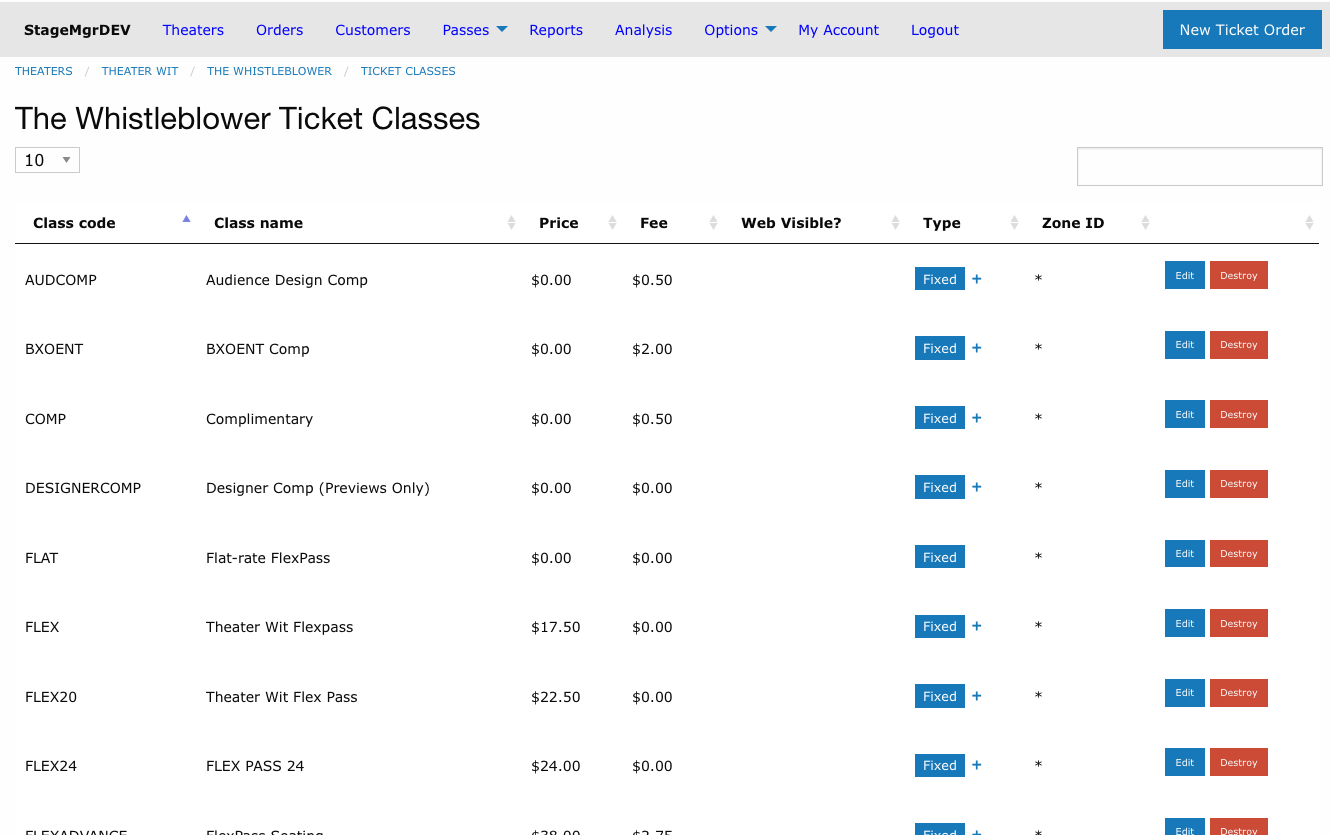
Auto-attaching classes are flagged in the ticket classes list: a blue + marker appears after the type tag in the Type column. Hover over the marker to see the tooltip "Added automatically to orders." Classes without the marker must be added to performances manually.
When to Use Auto Attach
Enable auto attach for ticket classes that apply to every performance (e.g., General Admission, Senior). Disable it for special one-off classes (e.g., Opening Night VIP) that only apply to specific performances.
Examples
Standard Setup
A typical production might have these ticket classes:
| Code | Name | Type | Price | Fee | Web Visible | Notes |
|---|---|---|---|---|---|---|
GA |
General Admission | Fixed | $35.00 | $3.00 | Yes | Default ticket |
SR |
Senior (65+) | Fixed | $25.00 | $3.00 | Yes | |
STU |
Student | Fixed | $15.00 | $3.00 | Yes | Purchase page annotation: "Valid ID required" |
COMP |
Complimentary | Fixed | $0.00 | $0.00 | No | Complimentary + hide pricing |
RUSH |
Rush | Timed | $15.00 | $0.00 | Yes | Minutes before show: 60 |
Industry Screening
For an invite-only industry event:
| Code | Name | Type | Price | Fee | Web Visible | Notes |
|---|---|---|---|---|---|---|
IND |
Industry | Fixed | $0.00 | $0.00 | No | Complimentary, hide pricing, suppress receipt |
Editing and Deleting Ticket Classes
- Click Edit next to any ticket class to modify its settings.
- Click Destroy to remove a ticket class (Administrator only).
- You cannot delete a ticket class that has sold tickets. Deactivate it by unchecking
web_visibleand removing it from performance allocations instead.