Performances
Required Role
Administrator or Box Office can create, edit, and manage performances. Only Administrators can delete performances.
Navigation: Productions > [Production Name] > Performances > New performance
What Is a Performance?
A performance represents a single scheduled showing of a production -- one specific date and time when the audience can attend. Each production has one or more performances, and each performance has its own ticket availability, allocations, restrictions, and special features.
Creating a Performance
- Navigate to the production's detail page
- Click New performance in the Performances section
- Fill in the fields described below
- Click Create Performance
Core Fields
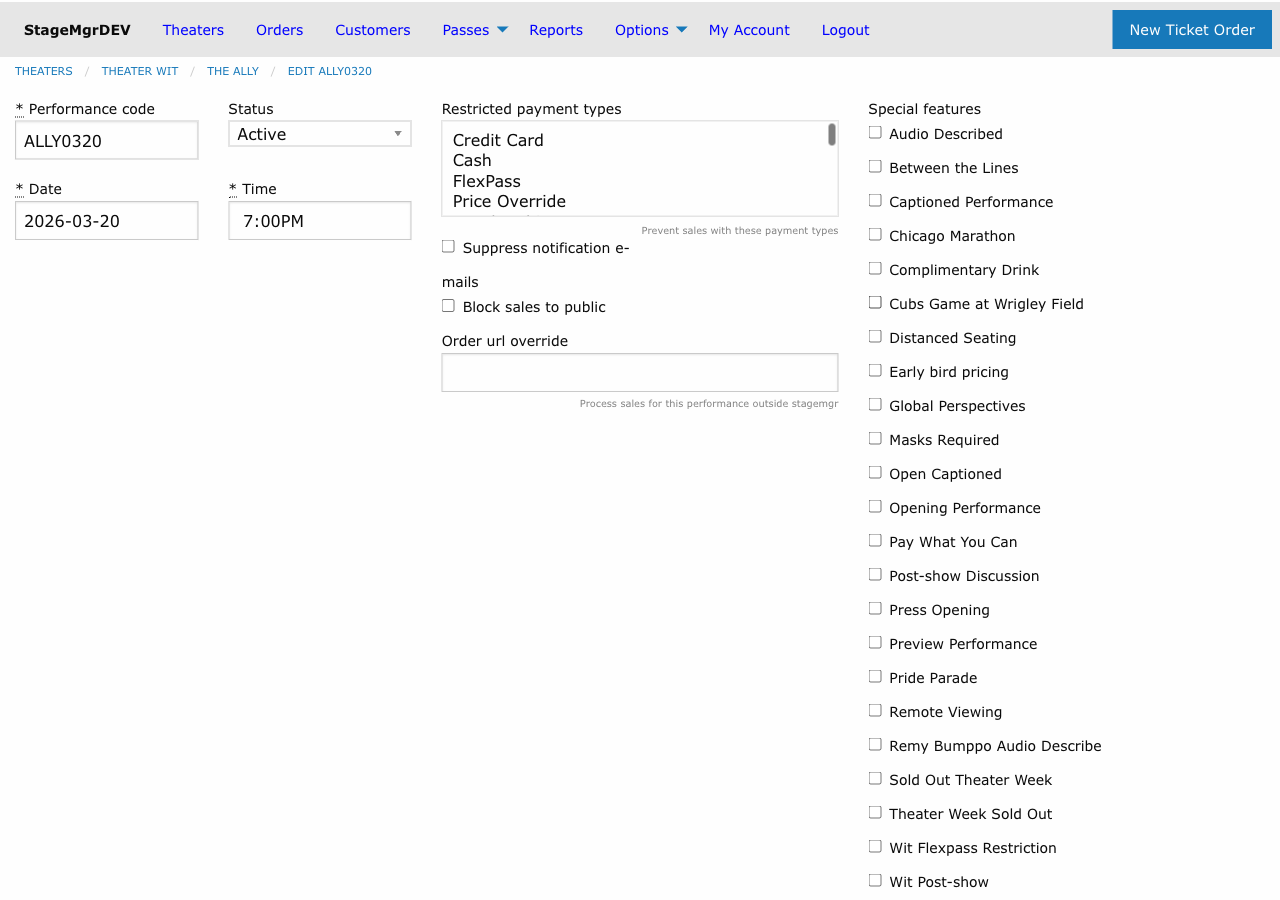
Performance Code
A unique identifier for this performance. Must begin with the production's production code prefix. Auto-uppercased on save.
Performance Code Conventions
If the production code is ROMEO, performance codes might be ROMEO01, ROMEO02, ROMEOPR (preview), or ROMEO0101 (January 1st). Use a consistent numbering scheme across your season.
Performance Date
The date of the performance. Defaults to today. Required.
Performance Time
The curtain time for the performance. Required. Times are rounded to the nearest 15-minute interval (e.g., 7:30 PM, 8:00 PM). Each date/time/production combination must be unique -- you cannot schedule two performances of the same production at the same date and time.
Status
Controls the performance's visibility and behavior.
| Status | Effect |
|---|---|
| Active | Performance appears on the public calendar and tickets are available for purchase |
| Inactive | Performance is hidden from public view and administrative lists (use to archive past performances) |
| Private | Performance is hidden from the public website but accessible to box office staff and via direct link |
Restrictions
Withhold from Public
When checked, this performance is blocked from public online sales. The performance does not appear on the website purchase page. Box office staff can still create orders for it.
Use case: Hold a performance for group sales, subscriber priority, or internal allocation before opening it to the general public.
Suppress Notification
When checked, Stagemgr does not send confirmation or notification emails for orders placed on this performance. The orders are processed normally, but patrons do not receive email.
Use case: Bulk-imported orders, internal testing, or comps where email notification is unnecessary.
Order URL Override
Enter a URL to redirect patrons to an external ticketing page instead of processing the sale in Stagemgr. When set, the "Buy Tickets" link for this performance points to the specified URL.
Use case: Performances sold through a partner organization's ticketing system, or co-productions where the other company handles sales.
Restricted Payment Types
A set of checkboxes listing available payment types. Check any payment types that should be blocked for this performance. For example, checking "Credit Card" prevents patrons from using credit cards -- they must use another accepted method.
Payment Restrictions
Be cautious with payment restrictions. Blocking common payment types may prevent most patrons from completing their purchase. Typically used for special events where only specific payment methods are accepted.
Special Features
Special Features Checkboxes
Select from the list of active special features defined in the system. Checked features are associated with this performance and may affect display, pricing, or patron communications.
Examples of special features: "Post-Show Talkback", "ASL Interpreted", "Audio Described", "Open Captioned", "Relaxed Performance".
Special Feature Display Markdown
Custom text displayed on the website for this performance, below the date and time. Markdown enabled. Use this for performance-specific announcements or details that differ from the standard production description.
Example: **Post-show Q&A with the director**
Special Feature Email Markdown
Custom text included in confirmation emails for orders on this performance. Markdown enabled. Use this for performance-specific instructions or reminders sent to ticket holders.
Example: *This performance includes an ASL interpreter. Interpreted seating is in the first three rows.*
Ticket Class Allocations
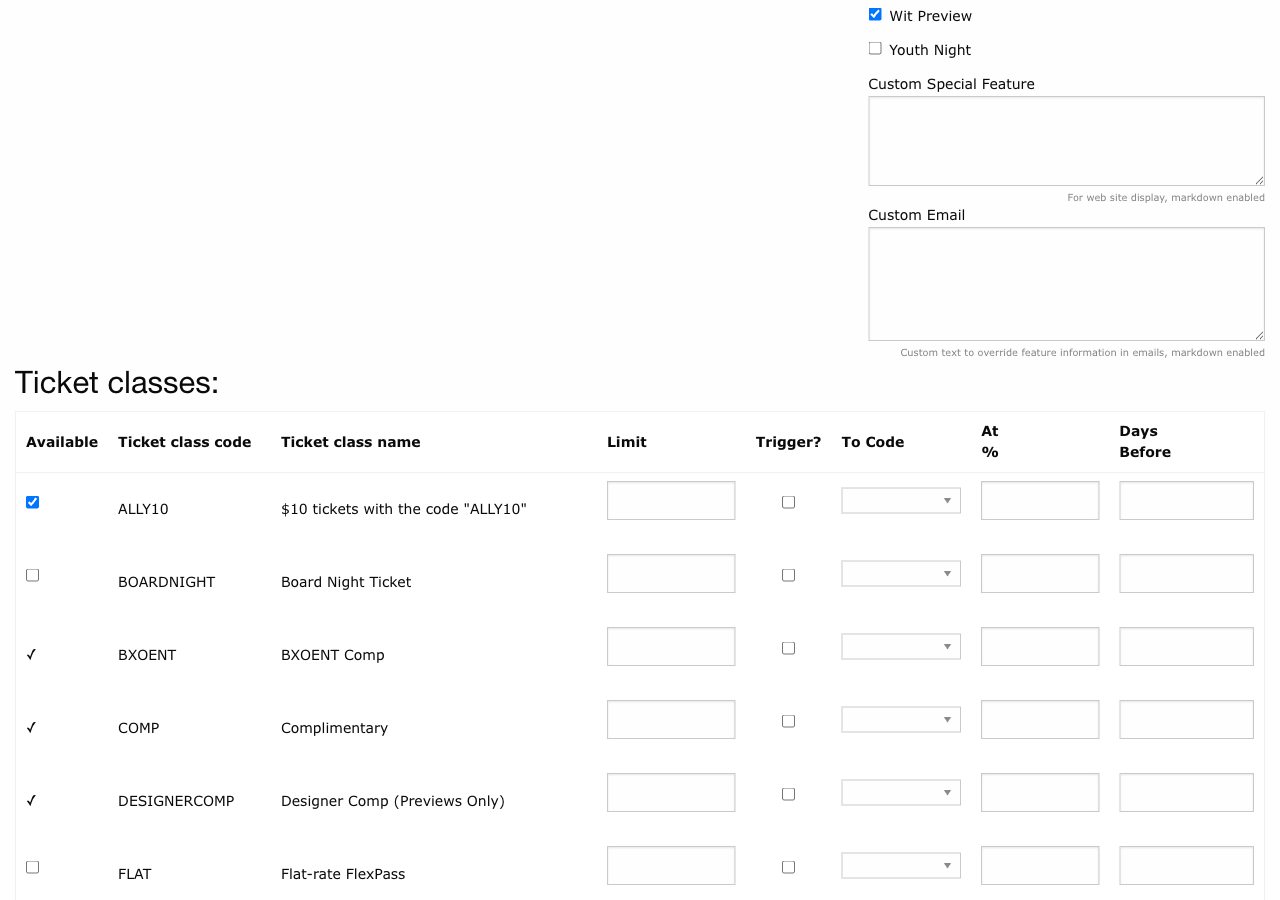
Below the performance form fields, the Ticket Class Allocations table controls which ticket classes are available for this performance and how many tickets of each class can be sold.
Each row in the table represents one ticket class with these fields:
| Field | Description |
|---|---|
| Available | Checkbox. When checked, this ticket class is on sale for this performance. |
| Ticket Limit | Maximum number of tickets that can be sold for this class. Entered in increments of 5. |
| Shiftable | Checkbox. Enables dynamic pricing for this allocation. See Dynamic Pricing. |
| Shift To Code | Dropdown. The target ticket class to shift sales into when the trigger is met. |
| Shift When Capacity Over | Percentage (0--100). Triggers the shift when overall performance capacity exceeds this threshold. |
| Shift Days Before Performance | Number of days. Triggers the shift when the performance is within this many days. |
Setting Ticket Limits
Ticket limits per class do not need to add up to the performance capacity. You can oversupply classes (e.g., 100 GA + 100 Senior for a 150-seat venue) if you expect one class to outsell the other. Stagemgr enforces the overall capacity limit regardless of per-class limits.
After Creating a Performance
Once the performance is saved:
- Review the allocation table to confirm the correct ticket classes are available and limits are set appropriately.
- Add special features if this performance has any (talkbacks, accessibility services, etc.).
- Test the public view by checking the production's page on the website to confirm the performance appears correctly.
To quickly create additional performances with the same settings, see Duplicating Performances.
The Performance List
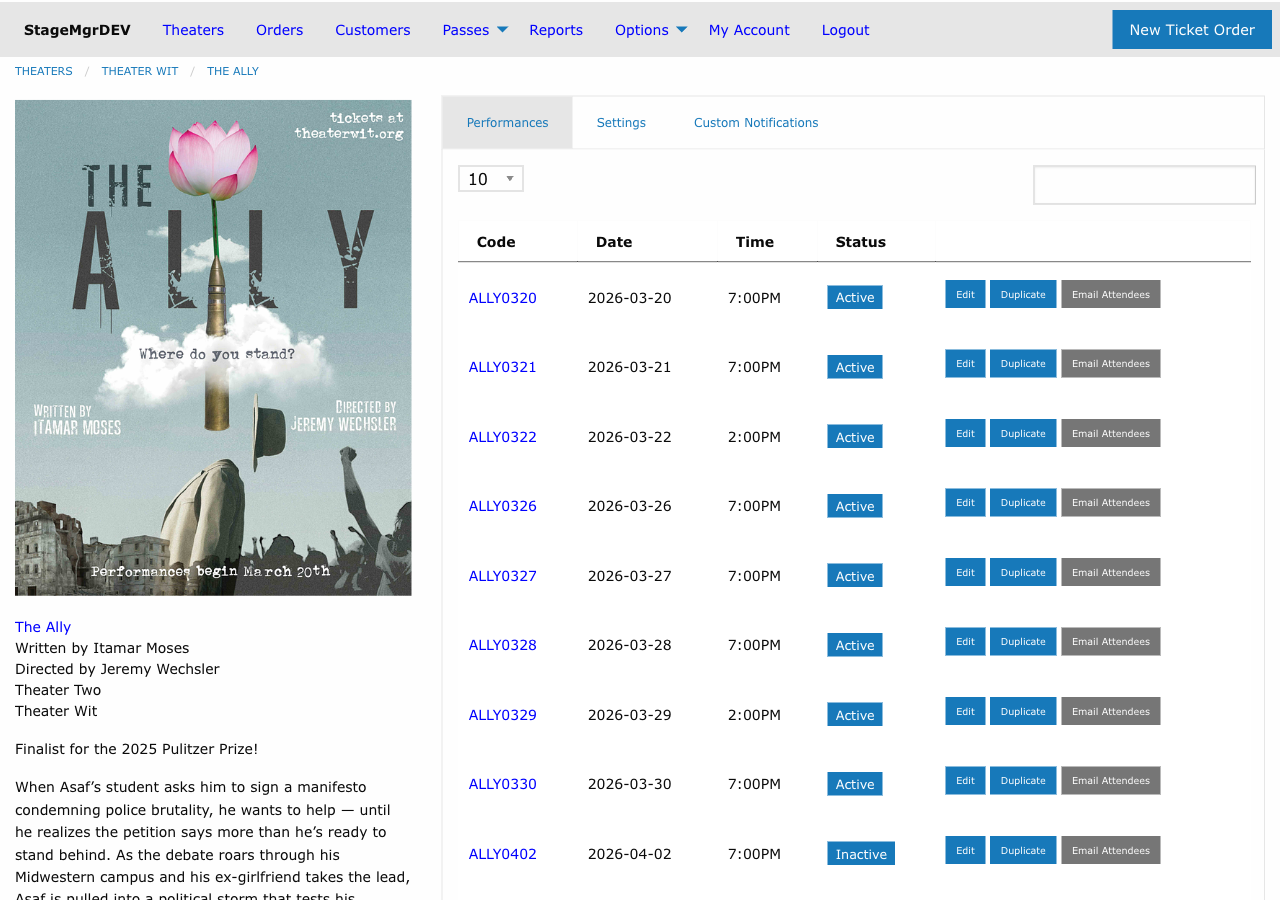
The production detail page shows all performances in a table with columns for:
- Performance Code -- Click to view/edit the performance
- Date and Time -- Scheduled date and curtain time
- Status -- Active, Inactive, or Private
- Sold / Capacity -- Current sales count vs. total available
- Actions -- Edit, Duplicate, and Destroy links
Use this list to monitor sales progress across the run and quickly identify performances that are selling fast or need attention.